|
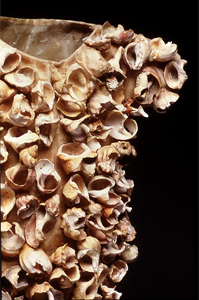

Sharp Shells, detail,
1999
cloth, shells, wax
19" x 12½" x 4"
from the Body Armor Sculptures Series
|
THE PERFECT FIT
Mass. sculptor, painter uses everyday objects
as raw material for art
by Joy Mazolla
Cambridge, Mass.-based artist Aparna
Agrawal recently exhibited her "Body Armor" sculpture
series in Lowell, Mass.
CAMBRIDGE, Mass. - "Before it was a choice. Now it isn't
a choice," says Aparna Agrawal
of the career which she has come to consider a vital part
of her life. "Art making is a way for me to understand myself,
my losses, the part of me that was closed off. It has really
shaped the person I want to be, the kind of energy I want
in the world, who I want to be around, and what I want to
contribute to this world. It has become completely and entirely
necessary for me to do it."
Agrawal is a sculptor and a painter. Sometimes she will spend
up to a year or more working in one medium or the other. Simple,
household materials, yellowy, light-emitting colors, and a
deliberate, labor-intensive process are common threads used
in much of her work to evoke a rich early childhood spent
with a large family in India.
The artist is still influenced by her earliest memories along
with being shaped by new experiences, good and bad. "Sometimes
I do [art]work to keep alive something that is fading, like
the part of my life which is India. Sometimes I make work
to try to process something that has a grip on my heart and
my soul," says Agrawal.
Agrawal uses everyday materials for her art, and for her
"Body Armor" series, used seashells, cloth, vials and paper.
Recently shown at the Brush Gallery in Lowell, Mass. were
Agrawal's "Body Armor" series: abstract sculptures representing
the armor one puts up to protect and hold tight to treasured
memories, like childhood. In these works, babies' "onesies"
are coated in beeswax and covered with her trademark household
or found materials, like seashells, cloth, paper and vials.
Says director and curator of the gallery Linda Poras, "While
her fragile figures evoke a sense of feminity and longing,
they are often cloaked in a protective shield or barrier and
completely self-contained."
The Tufts University Art Gallery currently has on display
a series of paintings that feature insect and larvae images
painted on pages from an archaic dictionary dug out of the
trash by a friend. "I'm a naturalist in that I closely examine
wasps' nests and larvae and scorpions, and examine all their
different colors and parts," says Agrawal, who has spent several
weeks each year for the last two decades in the Venezuelan
rainforest. "The dictionary text functions as a ground pattern,
and a different visual dimension," she says.
Agrawal's newer "Figure Sculptures" will be shown at the
MPG Contemporary Gallery in Boston beginning July 7th. These,
like many of her works, are about the body, particularly "its
presence, its fragment, its absence," Agrawal says.
Born in Delhi, Agrawal spent the first 10 years of her life
living with her immediate and extended family in Calcutta
and Lucknow. "I remember having a lot of people to play with,"
she says, "lots of cousins and aunts and uncles, a lot of
activity. I had a pretty incredible childhood. I think that
informs my artwork."
Many of Aparna Agrawal's
paintings juxtapose life against the background of ruins,
especially dilapidated Indian havelis, or bungalows. Agrawal
also paints everyday images in stark reality, and often uses
minimal color, in contrast to most art inspired by the Indian
subcontinent experience. Many of her paintings, such as the
ones below, are also inspired everyday images from India.
Agrawal's father, an architect, spent three years in Boston
before sending for his wife and three daughters. Agrawal,
now 47, arrived in Cambridge when she was 10 years old to
a much lonelier, more separated existence. "Cambridge was
much different in the 1960s. There were no Indian stores or
restaurants, and it was very hard to fit in racially and socially."
Agrawal attended the University of Massachusetts at Amherst
as a pre-med student and switched to business after two years.
After obtaining her M.B.A., Agrawal entered the telecommunications
industry where she worked mostly in product marketing, and
remained there for a decade. "I was really good at it but
remember trying to figure out what more I needed in my job,
and which parts didn't work," she says. "I started to have
an inkling that something creative was missing in my life."
Agrawal had been an artistic child, sketching a remarkable
likeness of relatives at family gatherings in her adolescence.
Even before that, she says, "I remember doing a lot of crafts
for religious rituals with my grandmothers, which I think
was the beginning of making things with my hands for practical
reasons, most of which were small, intricate, decorated with
beads and jewels and sequins. I still have a meditated labor
in a lot of my work which comes directly from that - it's
a very natural way for me to work."
In 1992, Agrawal enrolled full time in the School of the
Museum of Fine Arts. "My family reacted really oddly to my
leaving the business world," she says. "Many of my relatives
were very proud of me for having become the first businesswoman
in the family, and they didn't know what to say to me when
I went to art."
Many of Agrawal's early works embrace the childhood to which
she clung for years, the loss of that childhood, of India,
and her trips back to the land where she was born.
Says Poras, "I find that South Asian artists living in the
United States are confronted with the challenge of maintaining
their cultural heritage while adapting to the conventions
of contemporary art, and somehow managing to define themselves
in the process. And maybe that is why I was drawn to Agrawal's
work since it is evolved and timely."
Not all of Agrawal's work is about loss. Many of her pieces
and the methods whereby she creates them celebrate her heritage
and her youth.
She also makes sculptures using simple materials around the
house rather than art materials, the way she would have, had
she lived in India.
During one visit to India, Agrawal recalls, "I went to my
ancestral home in the north of India. There was an earthquake
that had decimated this beautiful old home. It was completely
earthquake ridden and the walls were decayed, but what really
fascinated me was that there were these jasmine gardens growing
inside the rubble." Agrawal's photos of this scene and her
resulting "Inside Garden Paintings," she says, "are about
how the garden can grow inside this decimated place, but also
about how your childhood is like a garden inside yourself
and it's always there, and green."
Agrawal has few regrets leaving business for art. She strives
to give back to the community through teaching and involvement
in nonprofit organizations. She has held several artist-in-residence
positions in Boston area schools, and will be heading a school-wide
sculpture project in Westwood, Mass. this fall.
Mass.-based sculptor and painter Aparna
Agrawal uses everyday objects like wire, cloth and
wax to make her pieces. Agrawal lives in Cambridge with her
husband, Willie Bloomstein, a writer, and their son.
Agrawal's paintings depicting insect and larvae images painted
on pages of an archaic dictionary are currently on display
at Tufts University.
|